
UseReading and discussion
CategoryReligion
SeriesKnowing God in Genesis / Genesis 3:12
Reading time13 minute read
"And the man said, The woman whom thou gavest to be with me, she gave me of the tree, and I did eat." — Genesis 3:12, KJV
1. He Told the Truth
Adam has been asked whether he ate from the tree God commanded him not to eat from.
He answers.
"The woman whom thou gavest to be with me, she gave me of the tree, and I did eat."
There is something important about his answer.
He tells the truth.
The woman gave him something from the tree, and he ate. Genesis has already told us that in the account of what happened.
Adam does not deny eating. He does not claim that someone forced the fruit into his mouth. He acknowledges his own action.
But his answer contains more than that acknowledgment.
He identifies the person who gave him something from the tree. And he tells God something about that person.
Why?
What does that additional information contribute to his explanation?
Before deciding, we need to look more closely at the person Adam identifies.
2. Not Just Any Woman
We have met this woman before.
In Genesis 2, God observed that it was not good for the man to be alone.
God acted to address that condition.
He made someone corresponding to the man and brought her to him.
Adam's response was remarkable:
"This is now bone of my bones, and flesh of my flesh."
He recognized someone who shared his humanity. She was not simply another living creature in the garden.
The narrative then described a man and woman becoming one flesh.
This relationship was unlike any other human relationship Genesis had yet described.
Now return to Adam's answer.
"The woman whom thou gavest to be with me..."
Those last four words are easy to pass over.
To be with me.
Adam does not merely identify the woman as someone God created.
He identifies her through the relationship God established between them.
God gave her to be with him.
That is the very relationship Adam now brings into his explanation of eating from the forbidden tree.
And suddenly his answer deserves a closer look.
Perhaps the relationship helps explain why her action mattered to him.
She was not a stranger offering him something. She was the person with whom God had established his companionship.
That does not tell us exactly what Adam thought when she gave him something from the tree.
We are not told that he ate because he trusted her, loved her, feared losing her, or assumed that someone God provided could never lead him into trouble.
But we do not need to invent those thoughts to recognize the importance of the relationship.
Adam himself identifies the woman through God's provision of companionship.
That is what his words give us.
And there is more.
3. Two Gifts, Two Givers
Listen again to the sentence.
"The woman whom thou gavest to be with me, she gave me of the tree, and I did eat."
The word give appears twice.
It is repeated in the Hebrew, too.
God gave.
The woman gave.
Adam ate.
Notice that the woman receives special emphasis. The Hebrew includes a separate word for "she," even though the verb already identifies her as the one who gave.
Adam's explanation places her prominently before his acknowledgment of eating.
But the two acts of giving are not the same.
God gave Adam someone to be with him.
The woman gave Adam something from the tree God had forbidden him to eat from.
The first act established companionship.
The second placed something forbidden within Adam's reach.
And Adam ate.
These actions belong to the same history, but they belong to different people.
That distinction matters.
Adam's words connect God's provision to his own disobedience. By mentioning that God gave him the woman, he makes God's action part of his explanation of what went wrong.
This can reasonably be heard as blame.
The woman gave him the fruit. And God, after all, was the one who gave him the woman.
But we should notice the difference between what Adam says and what we might conclude he intended.
He does not explicitly tell God, "You made a bad choice when you gave her to me."
His words may carry that accusation. They may also help explain why this particular person's action mattered so much to him.
Those possibilities are not necessarily opposites.
A person can explain why someone influenced a decision while also directing blame toward that person.
What we can see is that Adam's explanation reaches from his own action, through the woman's action, back to God's provision.
But does that make God's provision responsible for Adam's eating?
We need to distinguish the connection between actions from responsibility for those actions.
God's giving established a relationship.
The woman's giving was her action.
Adam's eating was his action.
The fact that one action made another possible does not automatically make the people involved equally responsible for what followed.
That distinction is especially important when the explanation begins to implicate God.
4. Admitting What Happened
Adam ends with a simple acknowledgment:
"And I did eat."
He does not deny the action.
But there is a difference between admitting what we did and explaining why we did it.
Adam tells God who gave him something from the tree.
He identifies that person through God's provision.
He acknowledges eating.
What he does not tell us is why he chose to eat.
We do not hear his reasoning. We do not know what he expected to happen. We do not know what he understood about the woman's action when she gave him something from the tree.
And we should not invent those details.
Nor should we assume that Adam has completely rejected responsibility.
He has acknowledged his own action.
The question is whether his answer also demonstrates that he accepts its full moral responsibility.
The verse does not settle that.
A person can tell the truth about an action while leaving important questions about the decision unanswered.
Sometimes an explanation helps us understand why a decision was made.
Sometimes it also directs our attention toward other people or circumstances.
And sometimes both things happen together.
Adam's answer makes those possibilities worth examining.
But we should not turn possibilities into facts about his hidden thoughts.
We know that he ate.
We know that the woman gave him something from the tree.
We know that he identified her through God's provision.
That is already enough to raise a serious question about how responsibility is being explained.
5. The Provision Had a History
Before we decide what Adam's explanation means about God, we need to remember what we have already witnessed.
God did not provide the woman without any disclosed reason.
He identified the man's aloneness as not good.
He acted to address it.
Adam recognized the woman through shared identity.
That history matters.
The woman Adam now identifies in connection with his disobedience is the same woman he previously recognized as bone of his bones and flesh of his flesh.
But listen to the difference.
Earlier, Adam spoke about who she was in relation to him.
Now, he speaks about what she did in relation to his eating.
We cannot say that Adam had always secretly resented her.
We cannot say that he had always questioned God's decision to provide her.
Genesis does not give us a complete account of his earlier thoughts.
We have not been shown a series of conversations between Adam and God before this event that would allow us to compare their earlier exchanges with this one.
But we have seen enough to recognize a change in what Adam's speech emphasizes.
Before the disruption, God provided, communicated, and gave Adam meaningful responsibilities.
Adam named the animals God brought to him.
He recognized the woman God provided.
The narrative does not record him objecting to those arrangements, although it does not tell us everything he thought about them.
Now God's provision appears in Adam's explanation with a different significance.
And this is not the first time we have encountered such a change.
The tree did not need to change materially for the woman to begin evaluating it differently.
Nakedness did not need to change materially for the humans to begin experiencing it differently.
Now the woman God provided appears in Adam's explanation in a way we had not previously encountered.
Something else is worth noticing.
In his earlier answer to God, Adam explained his fear and hiding by referring to hearing God's voice and recognizing his nakedness.
Now, when explaining his eating, he refers to the woman God gave him.
These are different explanations of different actions. We should not treat them as identical accusations.
But both explanations involve realities already connected with God's activity.
God's presence becomes part of Adam's explanation of fear.
God's provision becomes part of his explanation of eating.
The reader has already witnessed those realities before Adam began describing them this way.
That gives us an important advantage.
We are not required to understand God only through Adam's present experience of him.
We have watched God act.
We have seen his provision before it entered Adam's explanation of wrongdoing.
And we have seen his communication before Adam described hearing his voice with fear.
Adam's experience matters. His explanation matters.
But neither can erase the history we have already witnessed.
A person's changed experience of God does not, by itself, establish that God's character has changed.
We must continue examining God through his own disclosed actions.
6. When We Blame God for What People Do
There is something about Adam's answer that can make us examine our own explanations.
When something goes wrong, we often look backward.
Who made this possible?
Who introduced that person into my life?
Who gave someone the authority to act?
Who could have prevented what happened?
These can be important questions. Sometimes they help us identify responsibility that would otherwise remain hidden.
But there is a difference between identifying what made an action possible and identifying who is responsible for performing it.
That difference becomes especially difficult when human decisions cause enormous suffering.
People with power can make choices that affect millions. Innocent people may suffer from decisions they never participated in. Generations may inherit consequences from choices made long before they were born.
We live among the consequences of decisions we did not make.
And we make decisions whose consequences we may never fully see.
When suffering becomes terrible, people may ask why God did not prevent it.
That is a serious question. It should not be dismissed as though acknowledging human responsibility automatically answers it.
But two questions must remain distinguishable.
Who committed the wrong?
And why did God permit it?
Answering one does not automatically answer the other.
Genesis 3:12 does not resolve the entire problem of suffering or divine nonintervention.
It does, however, help us notice a distinction.
God gave the woman to be with Adam.
The woman gave Adam something from the tree.
Adam ate.
Those actions are connected.
But they are not identical.
God's having provided a relationship does not automatically make him the author of every decision made within that relationship.
That is worth remembering when we examine human wrongdoing, especially when its consequences extend beyond our ability to understand or control them.
And it is worth remembering when we examine our own decisions.
The fact that another person's action influenced us does not automatically remove our responsibility for what we chose to do.
7. God Is Still Listening
There is one Person we must not lose sight of while examining Adam's answer.
God.
Consider the conversation.
God called to Adam.
Adam answered, explaining that he heard God's voice, was afraid because he was naked, and hid.
God questioned him further.
He asked about Adam's awareness of nakedness and whether he had eaten from the forbidden tree.
Now Adam answers again.
He identifies the woman God gave him.
He says she gave him something from the tree.
He acknowledges eating.
The God asking these questions is not someone we have just met.
We have already watched him create, evaluate, provide, communicate, and establish meaningful human responsibilities.
His questions do not require us to forget what we already know about him.
Yet he engages Adam through conversation.
God asks.
Adam answers.
God asks again.
Adam answers again.
The exchange allows Adam to speak about his experience and his action.
It also allows the reader to hear how Adam understands what happened.
We should not assume that God asks because he lacks the ability to understand Adam's circumstances.
Nor should we claim to know God's complete purpose in using questions.
What we can see is that God's authority does not prevent Adam from participating in the conversation.
And this conversation is taking place after Adam has acted contrary to God's command.
That is a new circumstance.
Earlier, we watched God communicate with humans before their disobedience.
Now we watch him continue engaging a human being afterward.
The circumstances have changed.
Adam's experience of God's presence has become troubled.
His explanation of wrongdoing has implicated God's provision.
Yet the recorded exchange has continued.
We have not been told that God approves Adam's explanation.
We have not been told what God feels as Adam speaks.
We have not been shown God's response to this latest answer.
But we have witnessed continued engagement.
And that matters because the Person Adam is addressing is the same God whose provision Adam has now brought into his explanation.
Adam has spoken.
He has told God that the woman God gave him was the one who gave him something from the tree.
And he has admitted that he ate.
We know something about that woman.
We know something about God's provision.
We know something about Adam's action.
We also know something about the God Adam is speaking to.
We have watched him create, provide, communicate, and continue engaging the humans after their disobedience.
But we have not yet heard what God will say about Adam's explanation.
Will God's response confirm what we have already seen about him? Will it reveal something we have not yet understood? Will it challenge something we thought we knew?
We cannot answer those questions by deciding beforehand what God must be like.
We have to see what he does.
Keep watching him.
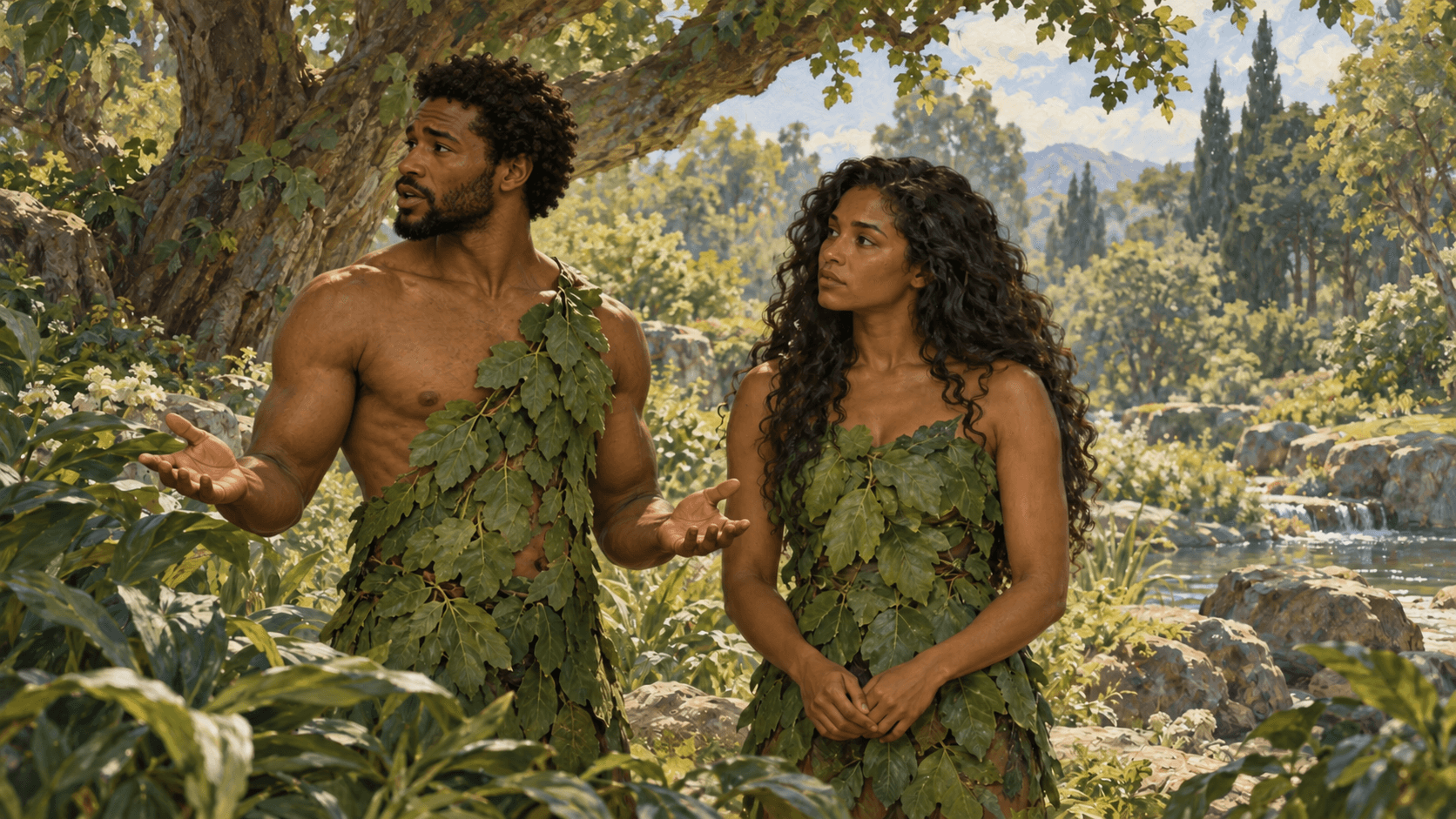
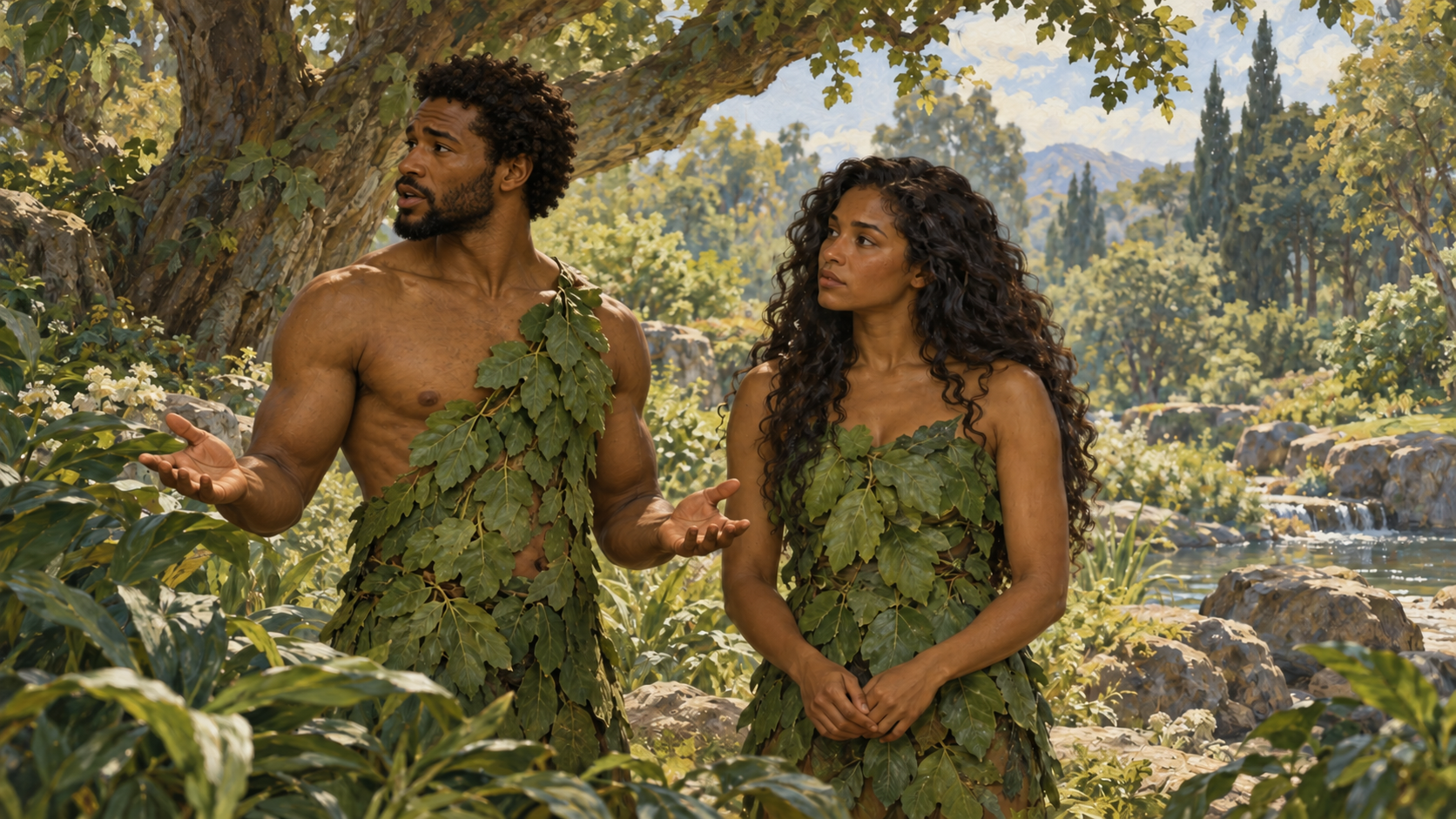
Source note: Scripture quotation: Genesis 3:12, King James Version (KJV). Evidence horizon: Genesis 3:12; Genesis 1:1–3:11 supplies prior revealed history only. Later verses are excluded. The Claim Audit preserves the approved findings, Argument Records, material revisions, open questions, and attribution limitations. The illustration is interpretive, not evidence of hidden motives or historical appearance.
Bibliography
- Genesis 3:12 — King James Version
- Genesis 3:12 — Hebrew text and commentary collection, Sefaria
- NET Bible — Genesis 3:12, translation notes
- Rashi and Sforno — Genesis 3:12, via Sefaria
- Ramban — Genesis 3:12:1
- Samson Raphael Hirsch — Genesis 3:12, commentary collection; exact edition attribution remains unverified in this publication pass
- The Torah: A Women's Commentary — Genesis 3:12 extract, via Sefaria; full edition metadata remains unverified in this publication pass
Claim Audit
Inspect the claim audit.
See the present status of this essay's claims, argument records, source links, and revision notes.
Open Claim AuditCommunity use
For discussion
Bring the question to a classroom, reading group, faculty meeting, leadership team, or learning community. Ask where conclusions are running ahead of the evidence and where stronger evidence could support stronger judgment.
Use This Page
Turn this essay into a conversation.
WhyDive essays are meant to help people discuss real questions with more care: belief, evidence, certainty, action, and consequence.