
Foundations

What is WhyDive?

WhyDive is a framework for strengthening judgment by helping people align conclusions with evidence.

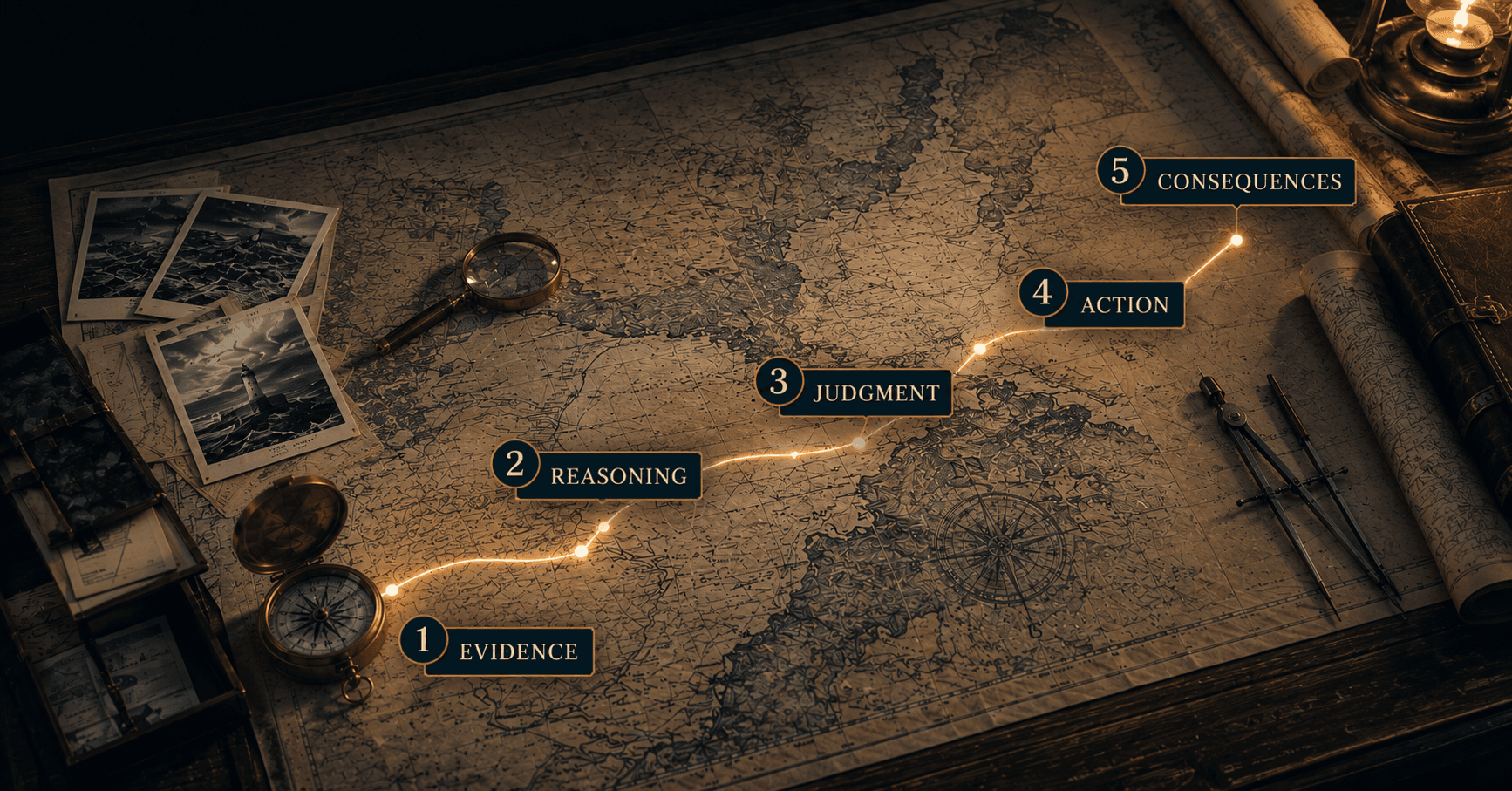
A navigation chart showing the WhyDive path from evidence through reasoning and judgment to action and consequences.

WhyDive is a framework for strengthening judgment.

It begins with a simple discipline: strong conclusions require strong evidence. The strength of what we believe, claim, recommend, or decide should not exceed the strength of the evidence supporting it.

That sounds obvious until ordinary life begins.

People make judgments from partial information. A chart suggests a trend. A report highlights one number. A text supports more than one interpretation. A leader must decide before every uncertainty has been resolved. An AI system gives a confident answer without showing what its confidence is worth. A public argument moves quickly from evidence to accusation, policy, identity, or action.

The problem is not only that people lack information. Often, the harder problem is that people move too quickly from information to conclusion.

WhyDive exists in that movement.

The Question WhyDive Asks

What conclusions are justified by the evidence available?

Every WhyDive application begins with that question. It does not ask only what we can notice, prefer, imagine, or argue. It asks what the evidence can responsibly support.

Boundary

Sometimes the evidence supports a strong conclusion.

Boundary

Sometimes it supports a cautious interpretation.

Boundary

Sometimes it supports only a possibility.

Boundary

Sometimes it shows that several explanations remain open.

Boundary

Sometimes it does not support the claim we want to make at all.

One way to picture WhyDive is as a navigation chart for judgment. Evidence does not become action by magic. It has to be interpreted, reasoned through, brought into judgment, and carried into decisions whose consequences matter. WhyDive makes that route visible so people can ask whether each step is justified by what the evidence can actually support.

WhyDive is concerned with evidence, but it is not trying to reduce human life to data. Evidence matters because it informs judgment. Judgment is what people use to decide what to believe, what to communicate, what to prioritize, and what to do.

A person can have accurate information and still reach a poor judgment if the conclusion outruns the evidence, ignores uncertainty, or treats a partial signal as proof.

That is why WhyDive does not stop at information literacy. Information literacy asks whether people can access, read, and evaluate information. Those are important skills. But WhyDive presses further into epistemic literacy: how people determine what they can responsibly conclude from the evidence they have.

More data can create more confidence without creating more justification. More fluent explanations can make weak claims feel stronger than they are. More evidence can even be misused when people pull it beyond its proper boundary.

The Problem of Overclaiming

A conclusion becomes stronger than the evidence behind it.

Overclaiming is not only a reasoning problem. It is also a responsibility problem. Claims affect other people. They shape trust, decisions, representation, policy, teaching, leadership, and action.

Overclaiming

treating a correlation as if it proves causation

Overclaiming

turning one example into a universal rule

Overclaiming

confusing confidence with justification

Overclaiming

presenting a possibility as if it were probability

Overclaiming

using a partial data point to support a sweeping claim

Overclaiming

ignoring uncertainty because certainty feels more useful

WhyDive does not ask people to become timid thinkers. It asks them to become proportionate thinkers. If the evidence is strong, say so. If the evidence is limited, say so. If the evidence is incomplete, preserve that uncertainty. If the evidence does not support the claim, do not pretend that it does.

Reasoning in service of judgment

Reasoning helps people examine what evidence means, what it supports, what it does not support, what assumptions are being made, and what alternatives remain possible.

Judgment uses that reasoning to determine what should be believed, communicated, prioritized, or done. WhyDive therefore treats reasoning as a pathway, not the destination. The destination is better judgment under evidence constraints.

WhyDive sequence

Evidence is often incomplete, uncertain, conflicting, emotionally charged, or mediated through institutions, charts, texts, models, stories, and authorities.

01Evidence
02Reasoning
03Judgment
04Action
05Consequences

Parent Framework

WhyDive is not first a curriculum, assessment, standard, product, or software platform.

Those can all become applications. At its root, WhyDive is a framework for understanding and improving how human beings move from evidence to action.

It is designed to travel wherever people must interpret evidence and form conclusions: charts, reading, writing, science, leadership, business, artificial intelligence, public discourse, theology, civic life, and everyday decisions.

This is also why WhyDive should not be confused with Chart-Ed. Chart-Ed is a flagship application of the broader WhyDive framework in graph literacy and data reasoning. It shows what can happen when the framework is applied deeply to charts, data, standards, assessments, and classroom resources.

Public purpose

WhyDive.org is the architectural home.

This site exists for foundational essays, whitepapers, research notes, conceptual explainers, and public-interest writing about evidence, reasoning, judgment, uncertainty, overclaiming, decision-making, AI, civic reasoning, leadership, and human flourishing.

WhyDive exists to slow down the movement from evidence to judgment, examine it, and strengthen it.

Strong conclusions require strong evidence. Dive into the why behind what you believe, conclude, and decide.

Source note

This article is based on internal WhyDive framework and ecosystem documents developed by Living Spiral Studio LLC. It is a framework orientation essay, not a literature review.

Use This Page