
UseReading and discussion
CategoryReligion
SeriesKnowing God in Genesis / Genesis 3:10
Reading time11 minute read
“And he said, I heard thy voice in the garden, and I was afraid, because I was naked; and I hid myself.”
— Genesis 3:10
God had asked Adam a question:
“Where are you?”
Adam does not answer with a location.
He tells God what happened inside him.
He heard God's voice. He was afraid. He says why he was afraid. Then he tells God what he did.
I heard you. I was afraid. I was naked. I hid.
For the first time since the humans hid among the trees, one of them tells us what the experience was like from the inside.
And Adam's explanation raises questions of its own.
“Because I Was Naked”
Adam knows whose voice he heard.
He does not say that he heard an unfamiliar sound and became frightened because he did not know who was approaching. He says:
“I heard thy voice.”
There is something Adam knows here that the reader does not.
Adam actually heard God's voice.
We only have the words on the page.
A voice can communicate more than words. Tone matters. The same sentence can sound welcoming, angry, urgent, disappointed, calm, or threatening depending on how it is spoken.
Adam heard that part of the encounter.
We did not.
If Genesis wanted to tell us what God's voice sounded like, it could have done so. It does not.
So Adam's fear cannot become evidence that God sounded angry. Neither can we decide that God sounded gentle. We simply do not know.
But Adam does tell us something we can know:
he was afraid.
And then he tells us why.
“because I was naked”
That answer sounds almost natural—until we remember the story we have already read.
Nakedness Had Not Been a Problem
Adam's nakedness is not new.
Before the serpent spoke, before the fruit was eaten, and before the humans hid, Genesis had already told us:
“And they were both naked, the man and his wife, and were not ashamed.”
The condition is the same.
The response is not.
Earlier:
naked — no shame
Now:
naked — covering, fear, hiding
That difference matters.
Something that had not been a problem has become a problem.
Genesis never established nakedness as a violation of God's will. God created the humans in this condition. There was no command requiring clothing. There was no warning that being seen naked by God would become dangerous.
Yet after their eyes are opened, nakedness becomes one of the first things the humans try to do something about.
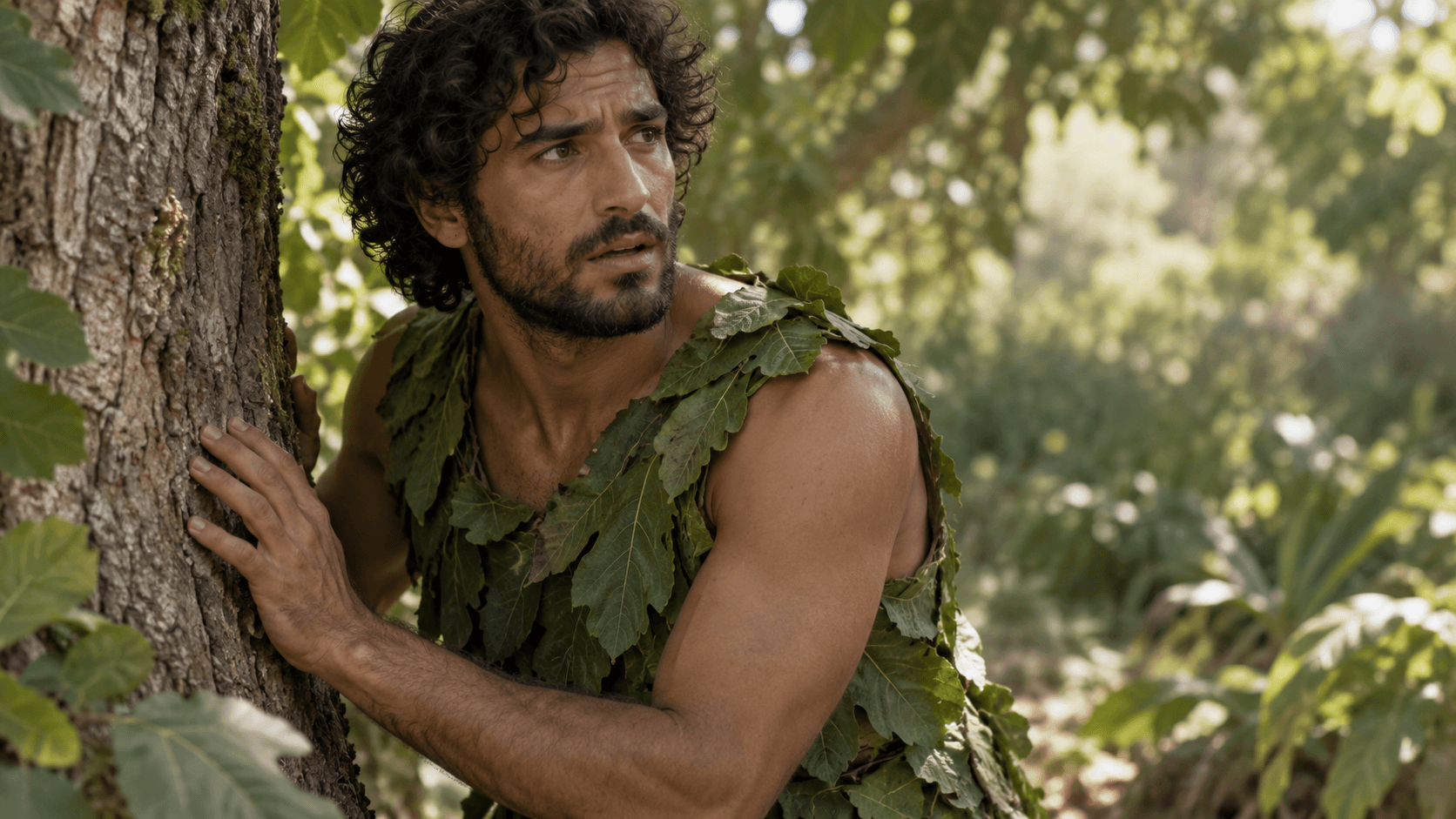
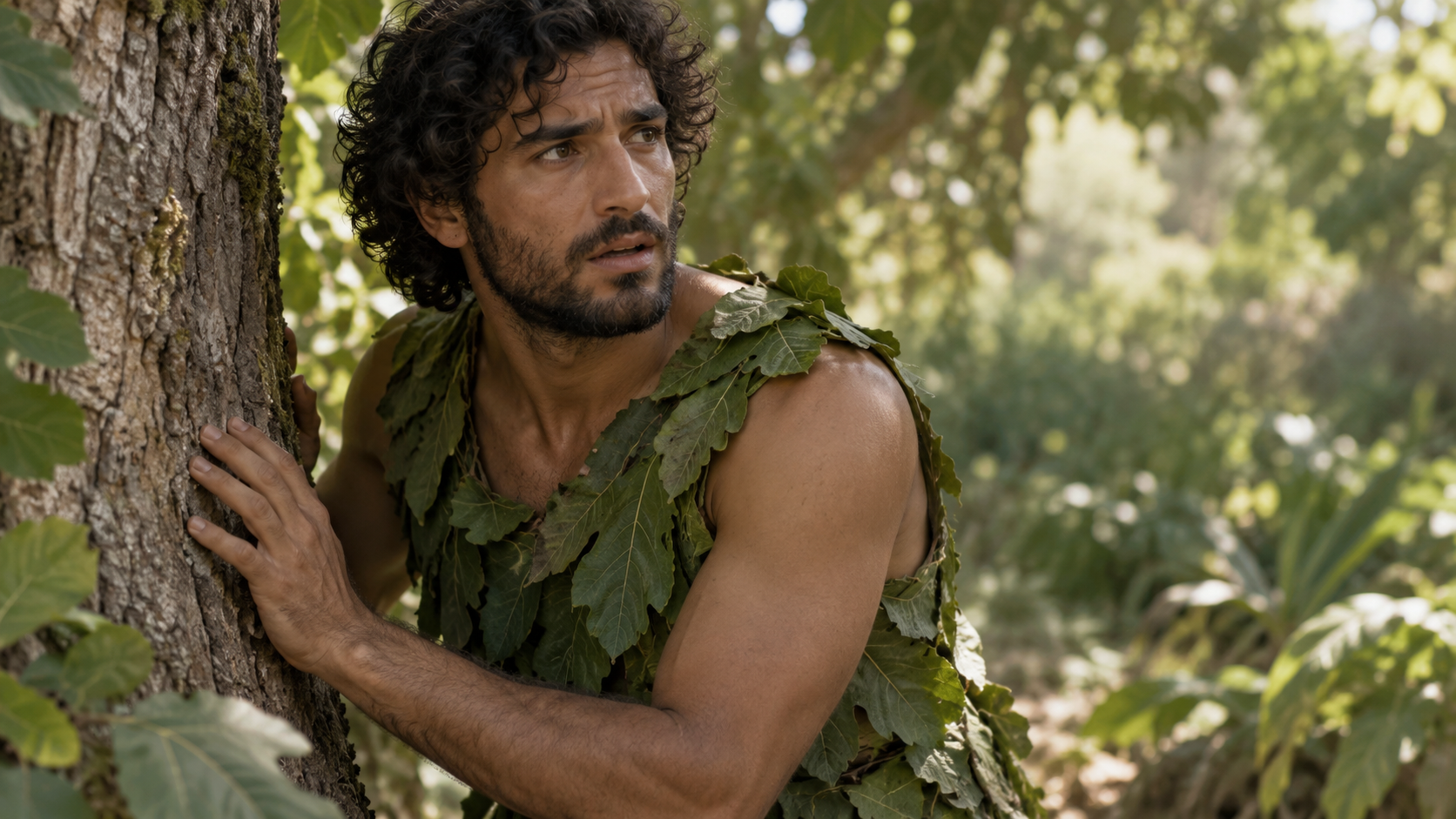
They sew fig leaves together.
They make coverings.
By the time Adam speaks in verse 10, nakedness has already become a problem to the humans.
But through this point in the story, something surprising remains true:
God has not called it a problem.
The humans have treated nakedness as something requiring a response before God has identified nakedness as an offense or a barrier between them.
That leaves us with a question that is harder than it first appears:
Why nakedness?
We can supply answers.
Shame. Guilt. Vulnerability. Exposure.
Each may help us think.
But Genesis has not yet told us why this condition—one that existed before anything went wrong—has suddenly become the condition Adam names when explaining his fear of God.
The question remains open.
But They Had Already Covered Themselves
There is another detail that makes Adam's answer even stranger.
Adam and his wife are no longer simply standing there without coverings.
They already made them.
Their eyes were opened. They knew they were naked. They sewed fig leaves together and made coverings for themselves.
Then God became perceptible in the garden.
They hid.
And when Adam explains himself, he still says:
“I was naked.”
We should be careful here.
Genesis does not tell us everything the humans expected their coverings to accomplish. So it would be too much to say simply, “The fig leaves failed.”
But we can say something smaller and more certain:
Whatever the coverings accomplished, nakedness was still a live problem for Adam when he heard God.
The leaves did not make the issue disappear from Adam's experience.
And now nakedness has moved beyond how the humans see themselves.
It has entered their relationship with God.
First They Covered. Then They Hid.
Look at the movement.
First the humans recognize their nakedness.
Then they cover themselves.
Then they become aware of God.
Then they hide themselves.
Something about them is concealed.
Then they are concealed.
We do not know whether the humans themselves thought of these actions as stages in one process. Genesis does not give us that psychology.
But the reader can see the progression.
And this raises another question:
Why hide?
That question becomes even more interesting when we remember who is approaching.
This is not a stranger entering the garden.
This is the God who created them.
The God who planted the garden and placed the man there.
The God who provided food.
The God who gave meaningful work.
The God who recognized that it was not good for the man to be alone.
The God who provided the woman.
The God who spoke clearly about what could be eaten and about the one boundary that could not be crossed.
The Provider has now become the Person from whom the humans hide.
Why?
Genesis has not yet told us.
Fear Is Real. It Still Doesn't Explain Everything.
Adam does give us part of the answer.
“I was afraid.”
We should not explain that away.
His fear is real because he tells us it is real.
But naming fear does not answer every question.
Fear can make someone run away from a person.
Fear can also make someone run to a person for help.
And that distinction becomes especially striking here because Adam is now speaking to the Provider.
He tells God:
I heard you. I was afraid. I was naked. I hid.
But he does not ask God for help.
That does not prove Adam refuses help.
It does not prove he believes God will not help.
It does not prove he has lost all trust in God.
Genesis has not told us any of those things.
Adam describes his problem to the Provider, and no request for the Provider's help is narrated.
That is worth noticing.
And again the question remains:
Why?
The Reader Was Waiting for Death
There is another reason Adam's answer deserves more attention.
Before the humans ate from the tree, God had already told them what consequence was attached to crossing the boundary:
death.
The reader has been prepared for that.
So after they eat, we might expect the story to revolve immediately around death.
But look at what Genesis actually gives us.
Their eyes are opened.
They recognize nakedness.
They make coverings.
They hear God.
They hide.
God calls.
Adam answers.
And Adam says:
“I was afraid, because I was naked.”
He does not say:
I heard you and remembered that I would die.
He does not say:
I thought you had come to kill me.
He does not say:
I hid because I knew the consequence was coming.
That does not prove Adam was not thinking about death.
He knew the warning.
Death remains part of the history.
But it is not the explanation Adam gives us.
The reader had been prepared for death.
Adam talks about nakedness.
Why?
Genesis has not told us.
Adam May Be Telling the Truth
There is a temptation at this point to decide that Adam is avoiding the real issue.
Perhaps he is making an excuse.
Perhaps he is refusing to admit what actually happened.
Perhaps “because I was naked” is simply not the truth.
But we do not need to accuse Adam of lying.
Adam may be telling us exactly how the situation now feels to him.
He hears God.
He experiences fear.
He understands his nakedness as the reason.
He hides.
That can be a truthful description of Adam's immediate experience.
But the reader has seen more of the story than Adam mentions in his answer.
We watched the serpent speak.
We watched familiar realities get described differently.
We watched the woman begin to evaluate the tree differently.
We watched the humans eat.
We watched their eyes open.
We watched nakedness become a problem.
We watched them cover themselves.
We watched them hide.
So Adam can truthfully tell us what he is experiencing now without explaining how his experience came to be this way.
And when we place Adam's answer beside that larger history, something striking happens.
His explanation centers on:
your voice
and:
my nakedness.
Hearing God is now part of the experience Adam connects with fear.
And nakedness—a condition in which God created the human—is now part of the explanation for hiding from God.
We do not have to say Adam is deliberately blaming God to notice what has happened to the relationship.
Something has changed in the way reality is being understood.
The Same Reality, Experienced Differently
This pattern did not begin with Adam's answer.
The tree did not have to become a different tree for the woman to begin seeing it differently.
And Adam's body did not have to become a different body for nakedness to acquire a different meaning.
Now the God who had created, provided, communicated, and given has become the Person from whom the humans hide.
Something objective has certainly changed.
The humans crossed God's boundary.
We should not reduce everything to a change in thinking.
But the boundary crossing alone does not explain why nakedness becomes the problem Adam names.
It does not explain why fear produces hiding from the Provider.
And it does not explain why death, the consequence God actually announced, is not what Adam talks about.
Genesis is showing us more than the arrival of a negative emotion.
The humans are beginning to experience familiar realities differently.
Their relationship to themselves has changed.
Their relationship to the garden has changed.
Their relationship to God has changed.
And those new meanings are shaping what they do.
Which God Are We Looking At?
This is where Adam's answer becomes especially important for a study of God's character.
Adam is afraid.
That is evidence.
But what is it evidence of?
It is certainly evidence about Adam.
Adam now experiences encounter with God through fear.
He hides from God.
But Adam's fear cannot, by itself, tell us what God is actually like.
That distinction matters.
A person can become afraid of someone without that fear giving us a complete or accurate description of the other person's character.
So we have to keep the evidence separate.
What are the humans doing?
They are hiding from God.
What has God done since they hid?
He has remained involved.
He called.
He asked Adam a question.
And Adam was still able to hear him.
Adam was still able to answer.
Adam was still able to tell God what he was experiencing.
That does not yet authorize us to call God gentle.
It does not yet authorize us to call him angry.
It does not establish mercy, forgiveness, hostility, or reconciliation.
Those words must wait for evidence.
But it does mean something important:
Adam's fear tells us what God has become like within Adam's experienced reality. It does not yet tell us what God is actually like in character.
For that, we have to watch God.
What Has Changed?
Genesis 3:10 leaves us with more questions than Adam's short answer first appears to contain.
Why nakedness?
Why does a condition that had not been a problem become the reason Adam gives for fear?
Why hiding?
Why does fear lead to concealment from the Person whose history with the humans has been creation, communication, and provision?
Why isn't death what Adam talks about?
The reader had been prepared for death. Adam gives us nakedness.
And why, while describing his problem directly to the Provider, does Adam not ask the Provider for help?
Genesis has shown us that Adam's experienced world has changed.
It has not yet shown us that God has changed with it.
Adam has told us where he is.
Now we need to keep watching the Person who addressed him there.
Keep watching Him.
Source note: The opening quotation is Genesis 3:10 in the King James Version (KJV). The essay stops at Genesis 3:10. The linked Claim Audit preserves the adjudicated claims, argument records, revisions, and open questions. Scholarly references retained in the supplied records are not a verified bibliography.
Claim Audit
Inspect the claim audit.
See the present status of this essay's claims, argument records, source links, and revision notes.
Open Claim AuditCommunity use
For discussion
Bring the question to a classroom, reading group, faculty meeting, leadership team, or learning community. Ask where conclusions are running ahead of the evidence and where stronger evidence could support stronger judgment.
Use This Page
Turn this essay into a conversation.
WhyDive essays are meant to help people discuss real questions with more care: belief, evidence, certainty, action, and consequence.